Open your Google Ads billing page and you might spot a line item called an "invalid activity" credit. It looks like a refund, so most advertisers assume the platform already handed back everything it owed. That assumption quietly leaves money on the table. Google returns money for invalid traffic in two different ways, and they're not the same thing. One is automatic and capped to what Google's own systems catch. The other is a claim you file, with evidence, for the invalid activity that filtering missed. In fact, fraud0's Unmasking the Shadows report (2025) found 21.3% of onsite traffic was invalid across 1.2 billion sessions (search-engine crawlers excluded), so the gap between the two matters. This post untangles them.
First, the vocabulary, because these four terms get used interchangeably and shouldn't be. An invalid-activity credit is money Google returns automatically when its own systems detect invalid clicks, with no action required from you. A Google Ads refund, as we use it here, is a claim-based return you initiate with evidence for invalid activity that automatic filtering missed. Invalid traffic (IVT) is any ad interaction that doesn't come from a genuine user with genuine interest, including bots, automated scripts, and accidental clicks. Ad fraud is the deliberate subset of invalid traffic engineered to drain budgets or fake performance. With those straight, the rest follows.
Key Takeaways
Google returns money two ways: automatic invalid-activity credits (Google-initiated, no action from you) and claim-based refunds (advertiser-initiated, evidence required).
Automatic credits only cover the invalid activity Google's own detection catches. They can't cover what the platform never saw.
In 2025, fraud0's Unmasking the Shadows found 21.3% of onsite traffic invalid (search-engine crawlers excluded), which shows automatic filtering leaves a gap.
Google almost always returns money as account credit toward future spend, not cash back to your card. Outcomes are never guaranteed.
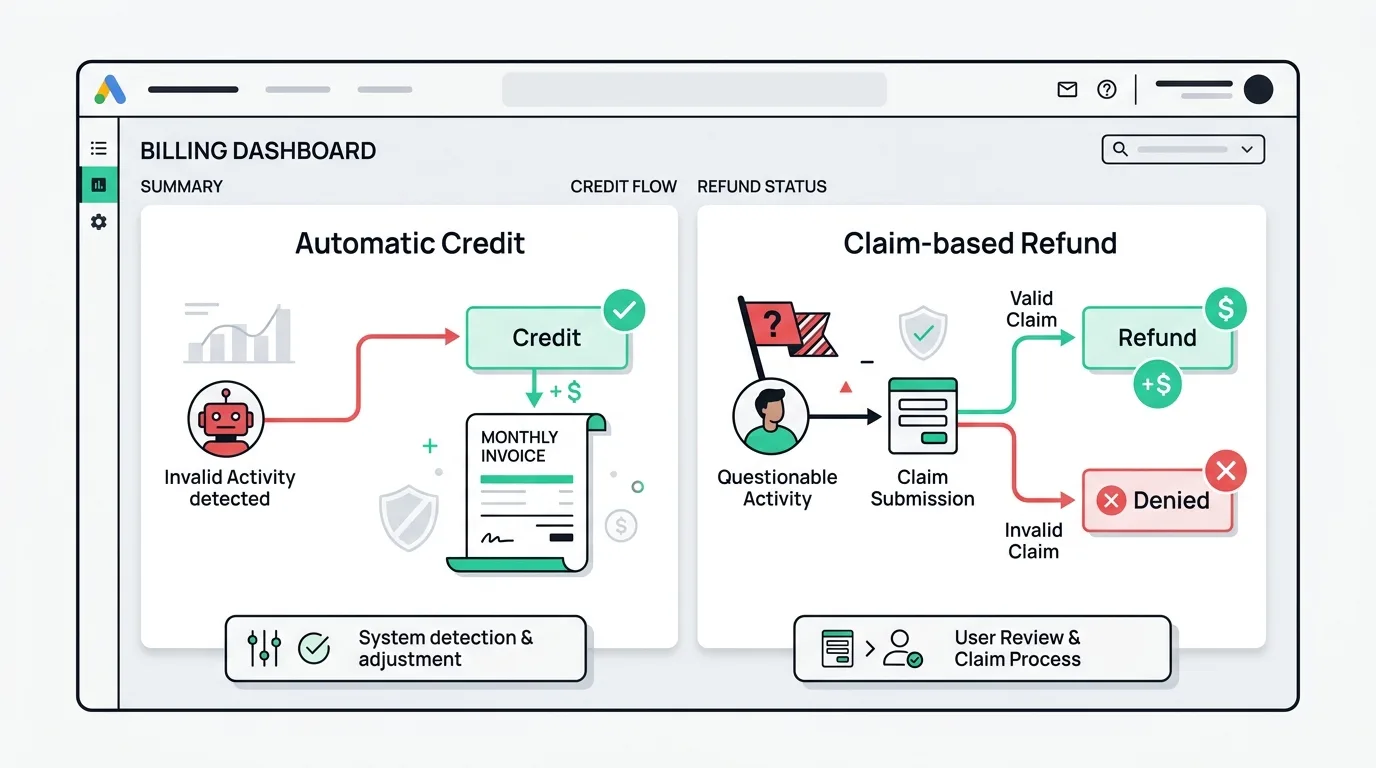
Here's the short version before we go deep. Both routes can put money back in your account, but they work differently and they cover different things. Knowing which is which tells you whether you've already recovered what you're owed, or whether there's more sitting in the invalid activity your dashboard never flagged. Let's separate them properly.
How does Google Ads return money for invalid traffic?
Google Ads returns money for invalid traffic through two separate mechanisms, and advertisers routinely conflate them. The first is automatic: Google's own systems filter invalid clicks and credit you without being asked. The second is claim-based: you file an inquiry with evidence for invalid activity that filtering missed. In 2025, fraud0's Unmasking the Shadows report found 21.3% of onsite traffic was invalid (search-engine crawlers excluded), so both routes exist for a reason.
The distinction comes down to who starts the process and what it can cover. Automatic credits are Google-initiated and require nothing from you. Specifically, they reflect whatever Google's detection identified as invalid. Claim-based refunds, in contrast, are advertiser-initiated. As a result, you bring evidence of invalid activity you believe was charged, and Google's ad traffic quality team reviews it.
In 2025, fraud0's Unmasking the Shadows report analyzed 1.2 billion onsite sessions and 10.78 billion ad impressions and found 21.3% of onsite traffic invalid (search-engine crawlers excluded). Google returns money for invalid traffic two ways: automatic invalid-activity credits initiated by Google, and claim-based refunds initiated by the advertiser with supporting evidence.
Why does this matter to your wallet? Because the two routes don't overlap cleanly. Automatic credits cover what Google sees. A claim, on the other hand, addresses what it didn't. Therefore, if you only ever rely on the automatic route, your recovery is capped at the platform's own detection, and that's the gap this post is about. For the full recovery playbook, see our guide on how to recover wasted ad budget.
Invalid activity is one reason Google returns money, but not the only one. Google also credits overdelivery past your monthly limit and corrects billing errors. Those routes are covered in ad-spend overbilling.
What are Google Ads invalid-activity credits?
Invalid-activity credits are money Google returns automatically when its systems detect invalid clicks, with no action required from you. According to Google Ads Help, the platform filters invalid clicks using automated systems and manual review, then either avoids charging you or credits invalid activity it catches after billing. In 2025, fraud0's Unmasking the Shadows report still measured 21.3% of onsite traffic as invalid (search-engine crawlers excluded), which shows automated filtering catches some, not all.
These credits arrive in two forms. Notably, understanding both tells you what's already been handled before you ever think about filing a claim.
What is pre-charge filtering?
Pre-charge filtering happens before you're billed. According to Google Ads Help, Google's systems analyze each click and proactively filter ones they identify as invalid, so those clicks don't appear in your reports and you're never charged for them. Consequently, you won't see a credit line for this, because there was nothing to refund. The click simply never cost you money.
This is the cleanest form of risk reduction, and it's silent. Furthermore, it works in the background, and most advertisers never notice it because there's no visible transaction. However, the catch is the same as everywhere else here: it only filters what Google's systems flag in real time, before the charge lands. No filtering stops every invalid click. For example, a brand-new bot the systems have never seen lands its first click before any signal exists to flag it, so some invalid activity always gets through. That residual is exactly why the claim-based route stays essential.
What are post-charge invalid-activity credits?
Post-charge credits cover invalid activity Google detects after you've already been billed. According to Google Ads Help, when its systems identify invalid activity following a charge, Google credits the cost back to your account. This is the line item you might spot in your billing or transactions, usually labeled as an invalid-activity adjustment, applied against future spend.
In our experience, this is the credit advertisers point to when they say "Google already refunded me." And they're partly right. It's a genuine, automatic return. However, the misunderstanding is treating it as the full extent of what's recoverable. In other words, it reflects Google's detection, not the total invalid activity that actually hit your campaigns.
According to Google Ads Help, Google Ads filters invalid clicks two ways: pre-charge filtering that prevents the charge entirely, and post-charge invalid-activity credits that return money after billing when its systems detect invalid activity. Both are automatic and Google-initiated, and both are limited to what Google's own detection identifies.
What is a Google Ads refund, and how is it different?
A Google Ads refund here means a claim-based return you initiate, distinct from the automatic credit Google issues on its own. According to Google Ads Help on invalid clicks, if you believe you were charged for invalid clicks that weren't already filtered, you can submit an invalid-clicks inquiry to Google's ad traffic quality team. In 2025, fraud0's Unmasking the Shadows report found 21.3% of onsite traffic invalid (search-engine crawlers excluded), so missed activity is common enough to be worth pursuing.
The difference is who acts and what triggers the return. With automatic credits, Google does everything. With a claim, in contrast, you do the work: you identify the suspected invalid activity, you bring evidence, and you submit it for review. According to Google Ads Help, the team investigates, and where it agrees, it may issue additional credit beyond what was already filtered automatically.
According to Google Ads Help, advertisers who believe they were charged for invalid clicks that automatic filtering missed can submit an invalid-clicks inquiry to Google's ad traffic quality team. If the investigation agrees, Google may issue additional credit. This claim-based route is advertiser-initiated and evidence-driven, unlike automatic invalid-activity credits.
Here's the part most advertisers miss. Automatic credits and claim-based refunds aren't competing options, they're sequential. Specifically, the automatic credit handles what Google detected. The claim, meanwhile, addresses the remainder, the invalid activity Google's systems never saw. So the real question isn't "credit or refund?" It's "is there invalid activity beyond what Google already caught?" If there is, then the automatic credit alone under-recovers. Our full ad-spend refund guide walks through filing one.
Credits vs refunds: a side-by-side comparison
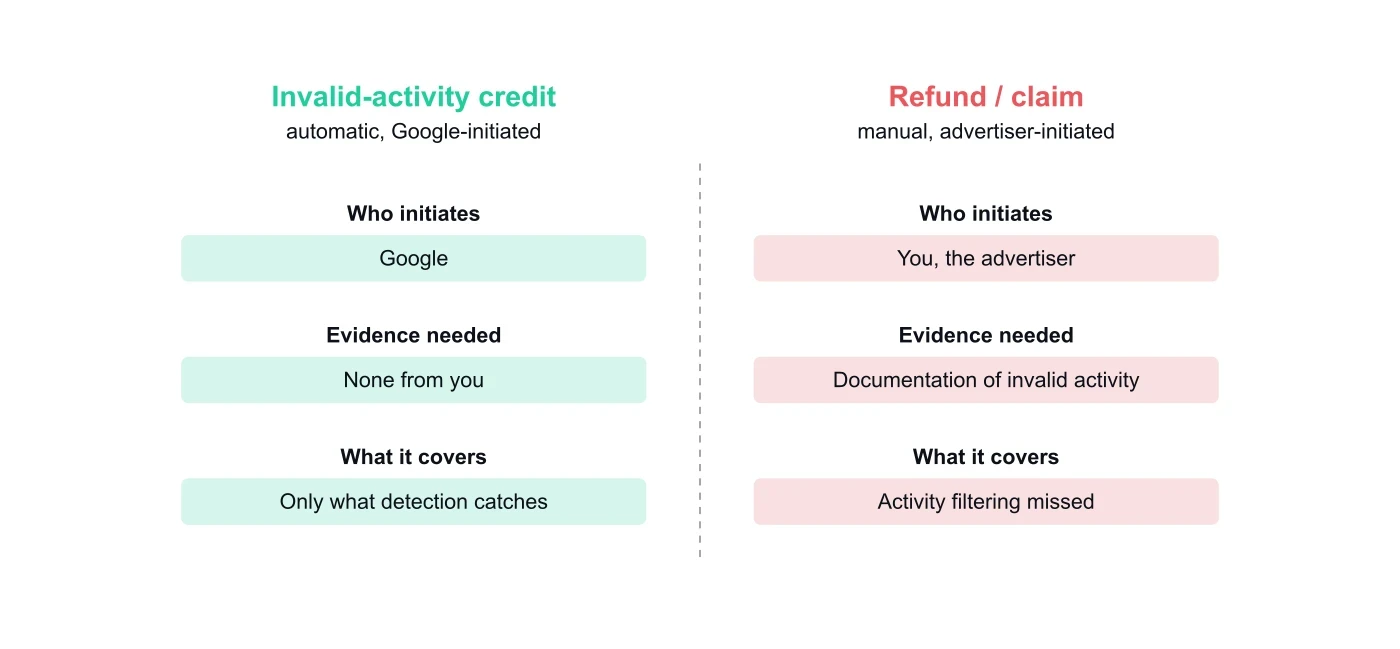
The cleanest way to see the difference is to put both routes next to each other. One is automatic and bounded by Google's own detection. The other, conversely, is a claim you build, aimed squarely at the invalid activity that detection missed. In 2025, fraud0's Unmasking the Shadows report found 21.3% of onsite traffic invalid (search-engine crawlers excluded), which is exactly the gap the claim route targets.
Invalid-activity credit (automatic) | Refund / claim (manual) | |
|---|---|---|
Who initiates it | You, the advertiser | |
What triggers it | Google's systems detect invalid clicks | You suspect missed invalid activity and file an inquiry |
Evidence needed | None from you | Documentation of the invalid activity |
What it covers | Only what Google's detection catches | Invalid activity Google's filtering missed |
Where you see it | Billing / transactions, as an "invalid activity" credit | A possible additional credit after review |
Form of return | Account credit toward future spend | Almost always account credit, not cash |
Guaranteed? | Automatic, but capped to detection | No. Depends on evidence and Google's review |
Source: Google Ads Help, invalid clicks and impressions; fraud0 analysis (2026).
Read down the "what it covers" row and the whole point of the post snaps into focus. The two routes recover different money. One closes when Google's detection closes. The other opens precisely where that detection ends.
Is a Google Ads "refund" actually cash or credit?
In almost every case, it's credit, not cash. According to Google Ads Help, invalid-activity adjustments are applied as credit toward your account, which reduces future ad costs rather than returning money to your card. Importantly, this holds for both automatic credits and most successful claims. In 2025, fraud0's Unmasking the Shadows report found 21.3% of onsite traffic invalid (search-engine crawlers excluded), so the recoverable amounts are real, but the form they come back in is usually a credit.
This matters more than it sounds. Specifically, a credit lowers what you spend next month. It doesn't top up your bank account. For your books and your cash flow, therefore, that's a meaningful difference, even though both are genuine recovery.
In our experience supporting recovery, setting this expectation early is what keeps the process honest. For example, we've seen stakeholders expect a cheque and feel let down by a credit, even when that credit is a real win. Notably, naming it accurately up front, "this returns as lower future media cost," avoids that disappointment entirely. The recovery is real. It just shows up as efficiency, not a deposit.
Why don't automatic credits catch everything?
Automatic credits are bounded by what Google's systems can see, and Google's systems work at the platform level, not on your site. They analyze click signals, but they don't observe what a visitor does after the click lands on your page. In 2025, fraud0's Unmasking the Shadows report found 21.3% of onsite traffic invalid (search-engine crawlers excluded), which is the activity that surfaces only once you look onsite.
This isn't a knock on Google. Rather, it's a limit of vantage point. No platform can fully see behavior that happens on your own property, after the visitor arrives. Onsite, first-party detection, however, sits exactly there, watching what the click does next: the page views, the session length, the behavioral signals that separate a bot from a buyer.
That difference in vantage point is the whole hinge. Platform filtering judges the click. Onsite detection, on the other hand, judges the visit. For instance, a bot can produce a click that looks clean to Google's pre-bid signals, then behave on your site in ways no platform-side system would ever catch. fraud0's data shows the pattern: invalid users averaged just 1.2 page views and 26-second sessions, versus 181 seconds overall. Significantly, that behavioral gap is invisible to the platform but obvious onsite, and it's the raw material an evidence-based claim is built from.
In 2025, fraud0's Unmasking the Shadows report found 21.3% of onsite traffic invalid (search-engine crawlers excluded), with invalid users averaging 1.2 page views and 26-second sessions versus 181 seconds overall. Platform filtering judges the click; onsite first-party detection judges what the visitor does next, surfacing invalid activity the platform cannot see.
So the automatic credit reflects what Google caught at the click. The invalid activity that only reveals itself onsite, meanwhile, is by definition outside that automatic number. As a result, that's the activity a documented claim can pursue. To build that record, see how to document invalid traffic as refund evidence.
How do you get a refund from Google Ads beyond the automatic credit?
You file an invalid-clicks inquiry with evidence, and you accept that the outcome rests with Google's review. According to Google Ads Help, advertisers can submit suspected invalid clicks to the ad traffic quality team, which investigates and may issue additional credit. There's no shortcut around that review, and no guarantee at the end of it. In 2025, fraud0's Unmasking the Shadows report found 21.3% of onsite traffic invalid (search-engine crawlers excluded), so the basis for a claim is often there.
The realistic sequence is straightforward. First, detect the invalid activity onsite, document what it was and when it happened, then submit through Google's defined inquiry channel rather than an informal complaint. Subsequently, Google reviews it against its own standards, on its own timeline, and decides.
A few honest caveats, because over-promising helps no one. From our work with advertisers, we found the recoverable balance varies widely from account to account. For instance, not every account has a large recoverable balance beyond the automatic credit. Not every claim succeeds. Moreover, even a strong, well-documented claim depends on Google's review, which sits outside your control. What documentation does, in fact, is give that review something concrete to assess instead of a hunch.
According to Google Ads Help, advertisers can submit suspected invalid clicks to Google's ad traffic quality team, which investigates and may issue additional credit beyond automatic filtering. Outcomes depend on the evidence supplied and Google's review, and credit is not guaranteed. Money typically returns as account credit toward future spend rather than cash.
Where this leaves you
The two routes recover different money, and that's the takeaway worth keeping. Automatic invalid-activity credits handle what Google's systems catch, with zero effort from you. A claim-based refund, in contrast, pursues the invalid activity that filtering missed, and it lives or dies on your evidence. In 2025, fraud0's Unmasking the Shadows report found 21.3% of onsite traffic invalid (search-engine crawlers excluded), so that second route often has something real to pursue.
So check your billing for the automatic credit, then ask the harder question: is there invalid activity beyond what Google saw? Importantly, remember that money almost always comes back as credit toward future spend, not cash, and that no claim is guaranteed.
That's where fraud0 fits. We make invalid traffic visible through onsite, first-party detection, surfacing the activity platform filtering leaves behind, and we help you document it for an evidence-based claim. No guarantees on Google's decision, just clarity on what's actually invalid and a documented path to act on it. Ready to go deeper? Start with our ad-spend refund guide.