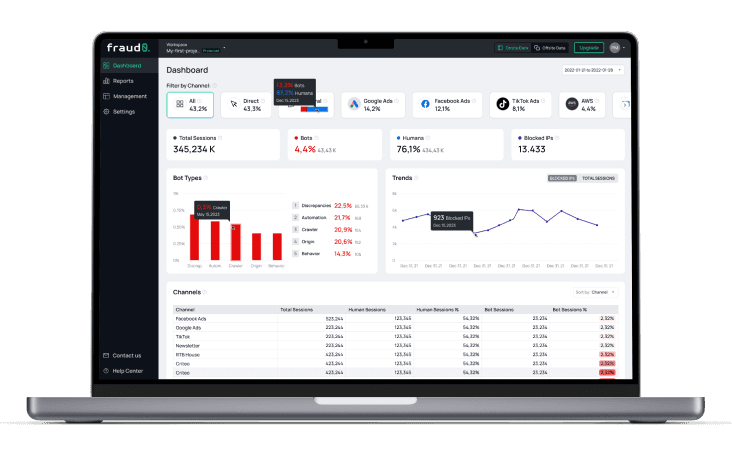
Most invalid-traffic advice stops at Google Ads. That leaves a problem, because your budget doesn't. If you run Meta, Microsoft, or TikTok campaigns alongside search, you're exposed on channels almost nobody writes about. Invalid traffic (IVT) is the bots, fake users, and automated activity that consume ad spend without ever becoming a customer, and the data says social channels can carry more of it, not less. In 2025, fraud0's Unmasking the Shadows report found Paid Social ran 20.6% invalid traffic versus 7.0% for Paid Search, nearly three times the rate (search-engine crawlers excluded where onsite figures apply). Specifically, this guide covers PPC protection across all three platforms: practical steps to reduce the waste, plus how to recover what slips through.
Key Takeaways
Paid Social carried 20.6% invalid traffic versus 7.0% for Paid Search in fraud0's Unmasking the Shadows 2025 report, so social and display channels often need more attention than search, not less.
Each platform filters some invalid traffic, but a brand-new bot's first click has no history to match, so it slips through.
Platform-level filtering can't see what traffic does after the click. Onsite, first-party detection unifies coverage across Meta, Microsoft, and TikTok that no single platform sees on its own.
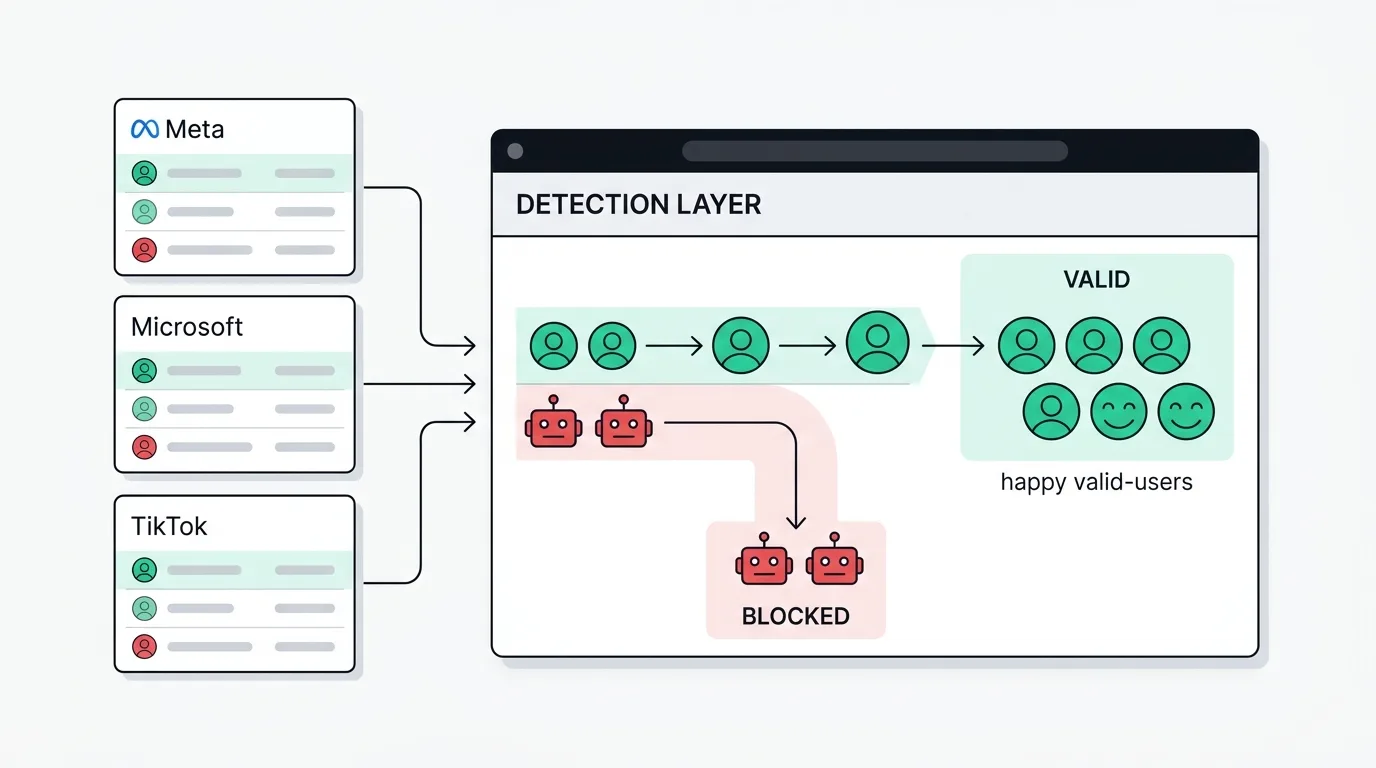
Here's the gap nobody talks about. The standard playbook was written for search, where the controls are mature and the advice is everywhere. But your media plan doesn't live on one platform, and neither does the invalid traffic. Cross-channel IVT is invalid activity that hits the same advertiser across more than one platform at once, so spreading your budget across Meta, Microsoft, and TikTok spreads your exposure too. Moreover, that exposure often lands on channels with thinner public guidance and higher measured risk.
This post fixes that. PPC protection is the practice of detecting and excluding invalid traffic from paid campaigns so budget reaches real prospects instead of bots. We'll start with why Paid Social changes the math, then walk through practical protection on each platform: exclusions, audience hygiene, and monitoring. After that we'll explain why onsite detection unifies coverage the platforms can't deliver individually. Importantly, we'll be honest about the limit: no setup stops everything, which is why recovery runs alongside protection. If you want the broader picture first, here's how to recover wasted ad budget across both arcs.
Why does Paid Social carry more invalid-traffic risk?
Paid Social tends to carry higher invalid-traffic risk than search, and the gap is wide. In 2025, fraud0's Unmasking the Shadows report measured 20.6% invalid traffic on Paid Social against 7.0% on Paid Search, nearly three times the rate. Worse, Paid Social showed the heaviest repeat-bot concentration of any channel: 71.6% of its bot sessions came from returning bots.
That repeat-bot finding matters more than the headline rate. A returning bot isn't a one-off. Instead, it's a source that keeps coming back, draining budget across multiple sessions, often mimicking an engaged user closely enough to pass a casual glance. Notably, Paid Social's targeting and feed-based delivery reward exactly the kind of repeat behavior these bots imitate, which is part of why the channel concentrates them.
In 2025, fraud0's Unmasking the Shadows report found Paid Social carried 20.6% invalid traffic versus 7.0% for Paid Search, and 71.6% of Paid Social bot sessions came from returning bots, the highest repeat-bot share of any channel. Higher-risk social and display channels need at least as much ppc protection as search, not less.
The wider web sets the backdrop. In 2024, Imperva's Bad Bot Report (Imperva, 2024 Bad Bot Report) concluded automated bots made up 51% of all web traffic, the first year machines overtook humans online. Consequently, when more than half of all traffic is automated, social platforms that thrive on volume and engagement become a natural landing zone.
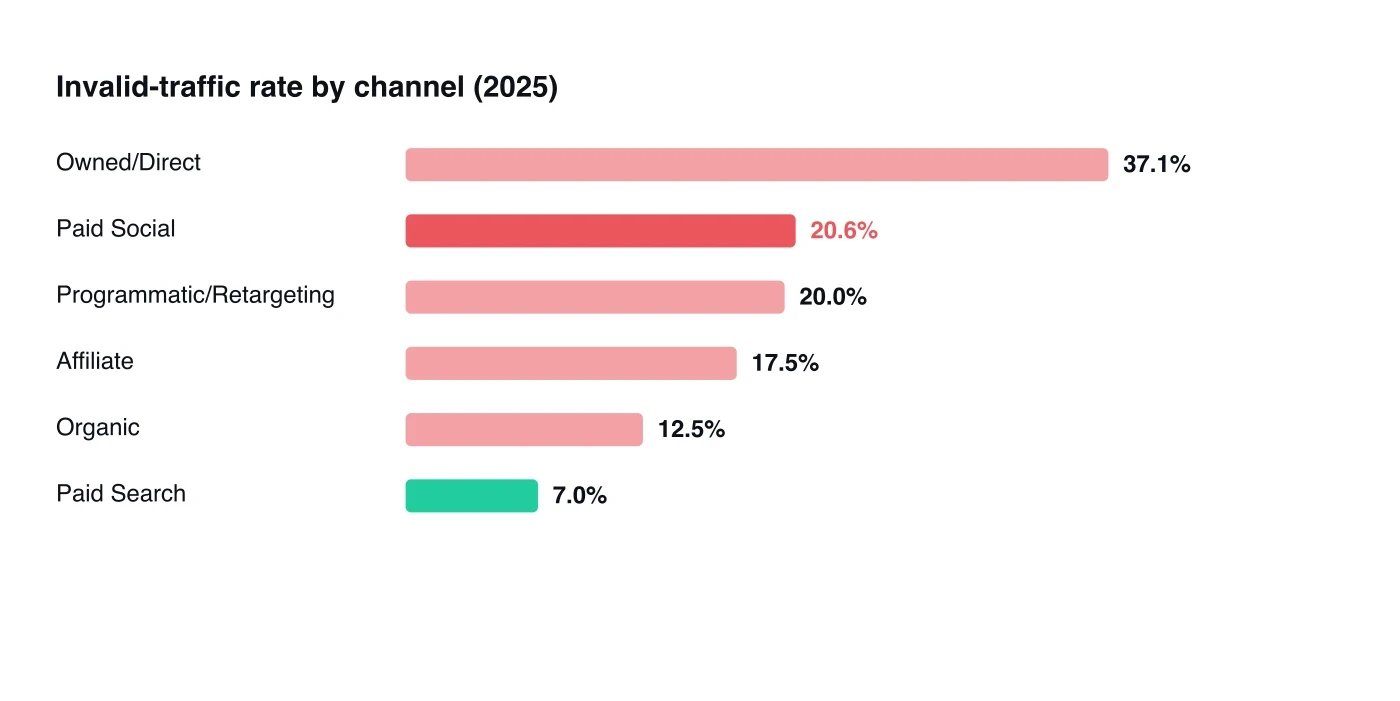
Source: fraud0, Unmasking the Shadows 2025 (search-engine crawlers excluded). Paid Social highlighted.
The common assumption is that search is where fraud lives, because that's where the conversation started. The channel data, however, flips that instinct. Paid Search showed the lowest invalid rate in the fraud0 breakdown, while social and display channels ran two to three times higher. Consequently, if your protection effort is all on Google Ads, you may be guarding your least exposed channel and leaving your most exposed ones open.
How do you protect Meta ads from invalid traffic?
Protecting Meta ads starts with audience hygiene and exclusions, because the platform's risk profile skews toward repeat invalid users. Specifically, Paid Social, the category Meta sits in, showed 20.6% invalid traffic and 71.6% repeat-bot sessions in fraud0's Unmasking the Shadows 2025 report. On Meta, therefore, the practical job is keeping invalid sources out of the audiences your campaigns optimize toward.
Clean your custom and lookalike audiences
Custom audiences built from site visitors or lead forms inherit whatever invalid traffic reached them. For example, if bots populated your source list, your lookalikes learn to find more of the same. Therefore, review the first-party data feeding your audiences and exclude sources you've identified as invalid, so the modeling starts from real humans rather than padded volume.
Watch your lead-form and conversion quality
Meta lead forms are fast to fill, which is exactly why they attract low-quality and automated submissions. In 2025, fraud0's Unmasking the Shadows report found 9.75% of conversions invalid (7.82% confirmed bots plus 1.92% suspected). Therefore, treat sudden spikes in cheap leads as a signal to investigate, not celebrate, and feed confirmed-invalid sources into your exclusions.
Apply exclusions, then monitor
Meta filters some invalid activity on its side, but that filtering works at the platform level and can't see what a visitor does once they reach your site. Meta is a supported audience-exclusion integration: onsite detection flags invalid visitors, the Facebook pixel event (F0Event-FB) writes them into a custom audience, and you exclude that audience at the campaign level so optimization stops chasing them. Then monitor: across the fraud0 dataset, invalid users averaged just 1.2 page views and 26-second sessions versus 181 seconds overall, so as an aggregate, invalid traffic engages far less than real humans.
In 2025, fraud0's Unmasking the Shadows report found Paid Social ran 20.6% invalid traffic with 71.6% repeat-bot sessions, and 9.75% of conversions invalid overall. For Meta ads, ppc protection means cleaning the audiences campaigns optimize toward and excluding invalid sources, since the platform filters some activity but can't see onsite behavior after the click.
How do you stop click fraud on Microsoft Ads?
Microsoft Ads carries the same cross-channel exposure as other paid platforms, and the protection logic mirrors search. In 2025, fraud0's Unmasking the Shadows report measured 21.2% of in-ad impressions as invalid alongside the 21.3% onsite figure (search-engine crawlers excluded), so the waste appears on both sides of the click. Microsoft filters some of it; however, the residual only shows up onsite.
Use IP and placement exclusions
Microsoft Advertising is a supported audience-exclusion integration, and it supports IP exclusions too, the same core lever you'd use on search. Where onsite detection flags an IP or source as a repeat invalid visitor, exclude it so it stops draining spend. Because Microsoft also serves across the Audience Network and partner placements, watch which placements deliver shallow, non-converting traffic and prune the ones that consistently underperform. Made-for-advertising (MFA) sites are low-quality, ad-stuffed pages built mainly to generate paid impressions rather than serve readers, so they often surface among the weakest partner placements worth pruning first.
Cross-reference with onsite signals
Platform-reported metrics tell you a click happened. However, they don't tell you whether the visitor behaved like a human afterward. Cross-referencing Microsoft's click data with onsite, first-party detection is what separates a real prospect from an invalid one. In particular, the attributes that distinguish a bot from a buyer, logged at the moment of the visit, are what justify an exclusion and, later, a recovery claim.
Microsoft Ads is often the channel marketers monitor least, simply because it carries less budget than Google or Meta. That's precisely why invalid traffic can sit there unnoticed. A lower spend doesn't mean a lower invalid rate; rather, it means fewer eyes on it. Similarly, the same per-user concentration that inflates risk elsewhere applies here, just with less scrutiny catching it.
For the search-specific mechanics that also apply to Microsoft, our guide on how to stop click fraud on Google Ads walks the exclusion workflow step by step.
How do you reduce bot traffic on TikTok ads?
TikTok ads sit in the same higher-risk Paid Social category as Meta, so the protection priorities are similar. In 2025, fraud0's Unmasking the Shadows report put Paid Social at 20.6% invalid traffic with 71.6% repeat-bot sessions, the worst repeat-bot share of any channel. On TikTok, accordingly, the practical work is monitoring engagement quality and excluding the sources that fake it.
Treat engagement metrics with healthy skepticism
TikTok's strength is engagement at scale, which also makes inflated or automated engagement harder to spot. For instance, a burst of clicks or video views that doesn't translate into downstream activity deserves scrutiny. Across the fraud0 dataset, invalid users averaged 1.2 page views and 26-second sessions against 181 seconds overall, an aggregate illustration of how much less invalid traffic engages than real humans.
Control your pixel and keep your data clean
Be honest about a real difference here: TikTok isn't an audience-exclusion integration the way Google Ads, Meta, or Microsoft are, so there's no negative-audience list to push flagged users into. The realistic lever is upstream. Use onsite detection to identify invalid sources, then control whether TikTok's pixel or tag fires for those flagged visitors, so they stay out of TikTok's retargeting and conversion data in the first place. Pair that with IP-level signals and analytics hygiene, and your seed signals model real humans rather than repeat bots.
In 2025, fraud0's Unmasking the Shadows report found Paid Social, the category TikTok ads sit in, carried 20.6% invalid traffic and 71.6% repeat-bot sessions, the highest of any channel. TikTok has no audience-exclusion integration, so reducing TikTok ads bots means detecting invalid sources onsite, controlling whether TikTok's pixel fires for flagged visitors, and keeping IP signals and analytics clean, since the platform filters some activity but not what happens onsite.
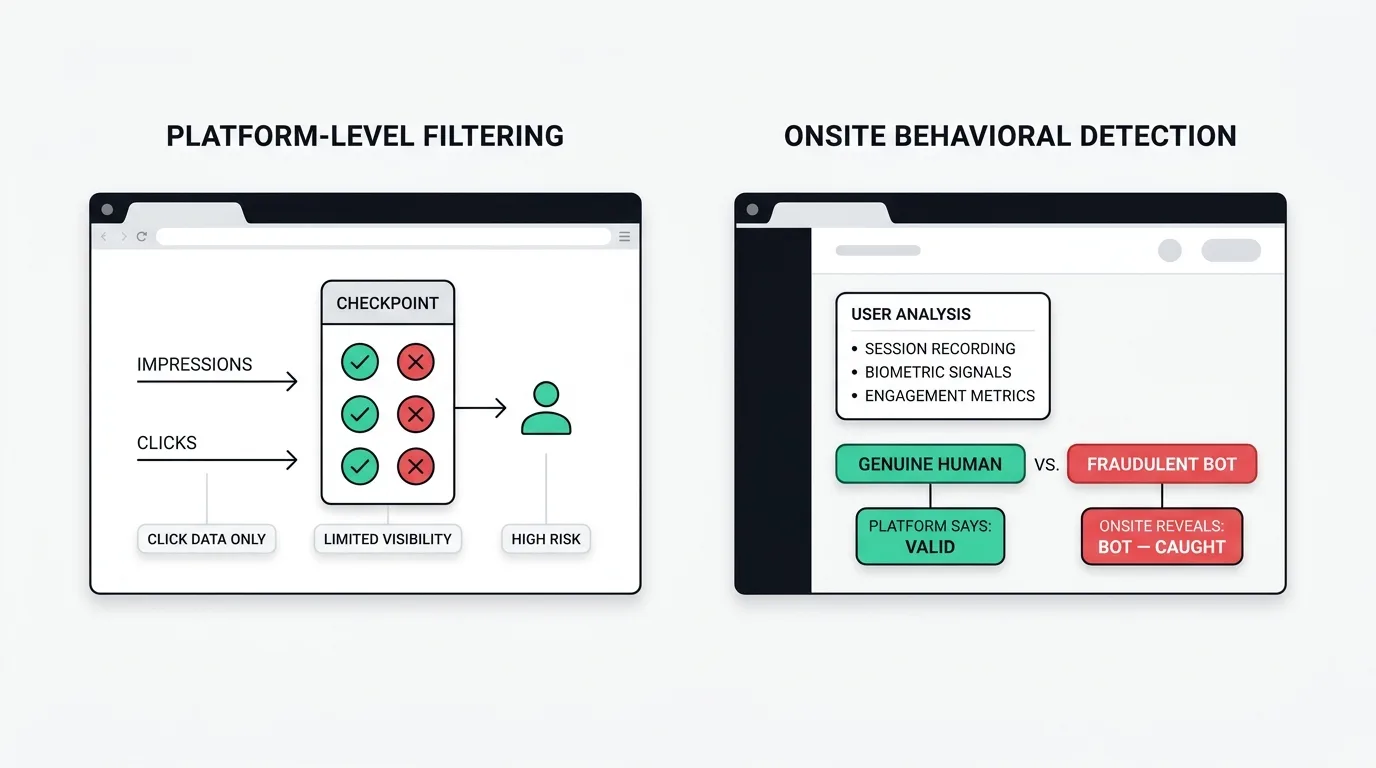
A reminder on framing here. None of this means TikTok, Meta, or Microsoft is doing anything wrong. In fact, every platform filters invalid traffic at its own level, and each catches a real share of it. The gap isn't intent. Instead, it's vantage point: no platform can see what a visitor does after the click reaches your site, and that's exactly where the rest of the invalid activity reveals itself.
Why does onsite detection unify cross-channel protection?
Onsite, first-party detection unifies what platform-level filtering can't, because it watches behavior after the click across every channel at once. In 2025, fraud0's Unmasking the Shadows report (fraud0, Unmasking the Shadows 2025) still found 21.3% of onsite traffic invalid (search-engine crawlers excluded), across 1.2 billion sessions. That residual, therefore, is the share each platform's own filter, working in isolation, doesn't catch.
The table below sums up the difference in vantage point that drives the whole problem.
Layer | What it sees | What it misses |
|---|---|---|
Meta filtering | Meta clicks and impressions | Other channels, plus all post-click behavior |
Microsoft filtering | Microsoft clicks and impressions | Other channels, plus all post-click behavior |
TikTok filtering | TikTok clicks and impressions | Other channels, plus all post-click behavior |
Onsite detection | Post-click behavior across every channel | Nothing on your site; it sits where all clicks land |
The structural reason is simple. Meta sees Meta traffic. Similarly, Microsoft sees Microsoft traffic, and TikTok sees TikTok traffic. None of them sees the others, and none sees what any visitor does once they land on your site. As a result, a bot that learns to pass one platform's filter can keep working, and a source hitting you across multiple channels looks like three separate small problems instead of one big one. Onsite detection, in contrast, sits at the destination every click shares: your site.
In 2025, fraud0's Unmasking the Shadows report found 21.3% of onsite traffic invalid (search-engine crawlers excluded) across 1.2 billion sessions, after standard platform filtering. Onsite, first-party detection unifies cross-channel ppc protection because it sees post-click behavior across Meta, Microsoft, and TikTok together, the vantage point individual platform filters don't have.
In our experience across multi-channel accounts, the recurring pattern is that the same invalid sources surface on more than one platform, yet no single dashboard reveals it. When we analyzed accounts running all three platforms, the waste hitting Meta and the waste hitting TikTok looked like two separate problems, because the two systems don't compare notes. Onsite detection is what merged them into one view. You still act per-platform, feeding each platform's own exclusion where an integration exists, but now you're working from a single picture of who's draining you, not three partial ones.
That unified view feeds both arcs of recovery. Specifically, the exclusions reduce future waste across channels, and the same logged evidence supports recovery claims for what already slipped through. If you're choosing a tool to do this, our click fraud protection buyer's guide covers what real cross-channel detection looks like versus IP-blocking with a dashboard.
What about the invalid traffic you can't prevent?
Some invalid traffic always gets through, on every channel, no matter how good the protection. In 2025, fraud0's Unmasking the Shadows report found 21.3% of onsite traffic invalid (search-engine crawlers excluded), which means some of the clicks you were charged for were never real. Consequently, that residual is what the recovery arc addresses.
The reason is structural, not a failure of any tool. For example, a brand-new bot's first click has no history to match against, so it can't be pre-blocked. Detection learns a source the moment it appears, then excludes it going forward; nevertheless, that first impression or click has already cost you. This is why honest PPC protection always pairs "reduce" with "recover." Protection cuts the leak; recovery, meanwhile, reclaims what leaked.
In 2025, fraud0's Unmasking the Shadows report found 9.75% of conversions invalid (7.82% confirmed bots, 1.92% suspected). Because a brand-new bot's first click has no history to pre-block, some invalid traffic always slips through, so ppc protection pairs reducing future waste with recovering the residual through evidence-based refund claims.
Here's the honest part. Where invalid activity is detected and documented, you can pursue recovery through each platform's process, but it's never guaranteed. Outcomes depend on what's actually detected and on the platform's review. Furthermore, when money does come back, platforms such as Google typically return it as an account credit toward future spend, not cash to your card. That's still a genuine win; notably, it shows up as lower future media cost rather than a cheque. Setting that expectation early keeps the process honest for everyone involved.
How to start protecting your cross-channel ad spend
Start by making the invalid traffic visible across every channel, not just search. After all, you can't exclude or recover what you can't see, and most of this waste never appears on a standard platform dashboard. Onsite, first-party detection is the entry point: specifically, it surfaces invalid activity across Meta, Microsoft, and TikTok in one unified view. From there you act per-platform. Where an audience-exclusion integration exists (Google Ads, Meta, Microsoft, DV360/CM360, Criteo), the detected sources feed straight back into that account's exclusions. Where one doesn't, as with TikTok, the levers are controlling whether the platform's pixel or tag fires for flagged visitors (keeping them out of its retargeting and conversion data), IP-level signals, and analytics hygiene.
From there the path is consistent across platforms:
Clean the audiences your campaigns optimize toward, so modeling starts from real humans.
Feed the invalid sources you've identified into each platform's own exclusion where an integration exists, and control the pixel where one doesn't.
Monitor engagement quality for the shallow sessions that signal bots.
Document what slips through so you can pursue recovery later.
Ultimately, the rule is the same on every channel: reduce the leak, then recover the residual.
That's where onsite detection earns its place. fraud0 makes wasted ad spend visible across your channels through first-party detection, then supports evidence-based recovery where invalid activity is found. Notably, there are no guarantees on the outcome, and no claim that protection stops everything, because it can't. Just clarity on where your budget is leaking and a documented path to act on it. If you're running paid campaigns beyond Google and suspect you're paying for traffic that can't convert, the honest next move is to look. To see your own numbers, contact the fraud0 team.